In a modern industrialized society, you would not think there could be a need to prohibit pushcarts. But that is just one of the strange road signs you will see in Japan.
Japanese road signs are, like so many other Japanese things, completely different yet somehow familiar. Japanese road signs are partly similar to international road signs, but Japan has a plethora of locally designed road signs which are difficult for visitors to interpret – and sometimes also for locals. Some of them make a uniquely Japanese interpretation of international concepts. But most of them are completely unique to Japan, and does not look like anything you would find anywhere else.
1. There Are Four Kinds Of Stop Signs
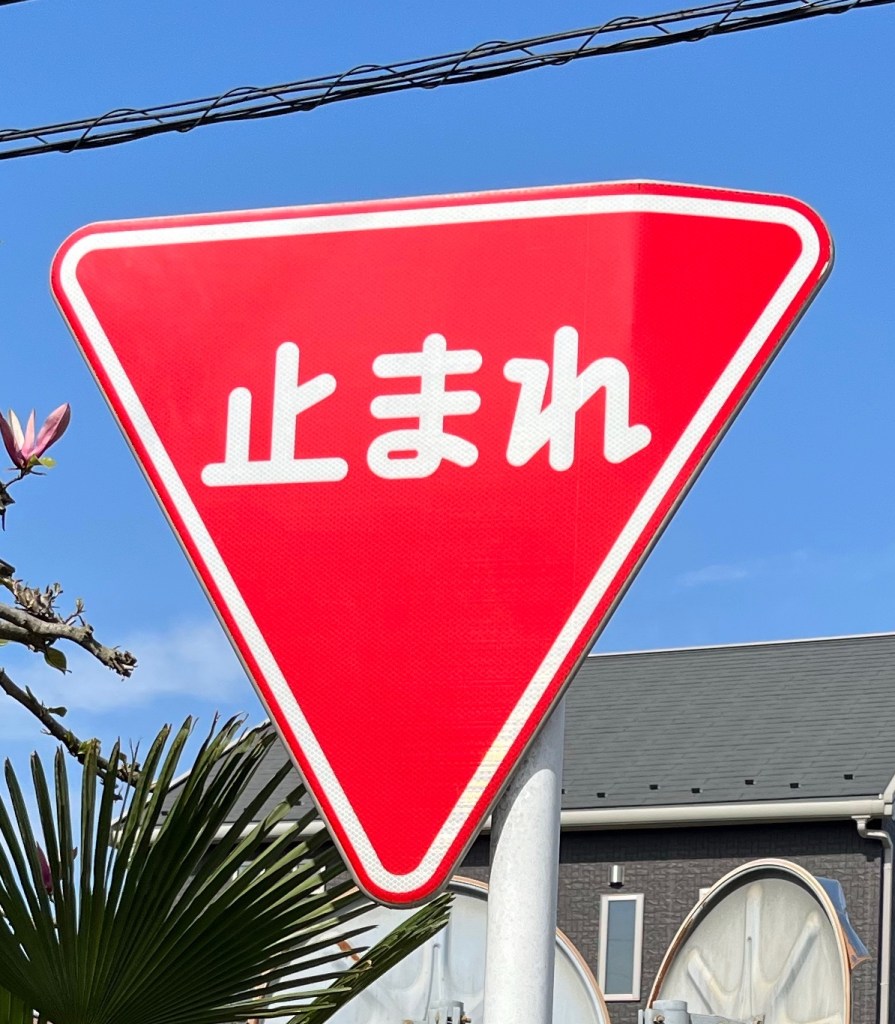
Driving in Japan, you will be required to come to a full stop almost every time you come upon a bigger road. And you will meet the Japanese stop sign.
The Japanese stop sign is an inverted triangle with the Japanese characters for the word “stop” (止まれ) on it. The words “stop” in Japanese are also written on the road as well, in front of the stop line. Each car has to come to a full stop, and one of the most common jobs for graduates from the police academy is to watch out for violators.
But in Japan, there is not just one stop sign, but four. The three other stop signs look like the normal stop sign from a distance (all an inverted red triangle, all with the same meaning).
The first of the new stop signs, which was introduced for the Tokyo 2020 Olympic Games in 2021, has the Japanese characters for “stop” and the word “stop” in the Latin alphabet. The second kind has the Japanese word for “stop” in phonetic katakana characters (トマレ). Sometimes, this is combined with the Japanese characters for “stop”. And then, there is the fourth kind, with only the word “stop” in the Latin alphabet – which many elderly Japanese can not read.
Since road signs in Japan are being replaced very slowly, it is unlikely that these new stop signs will take over anytime soon. And the word “stop” in Japanese painted on the road bed is not likely to change anytime soon.
Read more about the rules of the road in Japan here
Read more about the most common road signs in Japan here

2. Push Carts Prohibited
Push carts used to be a very common transport in agricultural areas. In the cities too, before motor vehicles became common. Apart from bicycles, they were the favorite human-powered goods transport. In most places, they have been replaced by motorcycles, mopeds, or the ubiquitous “kei” car that are the farmers workhorse. But they are still in use for short transports and gardening in rural areas, especially where elderly farmers keep working the family plots close to their homes. As a result, in the Japanese countryside you will still find places where there are signs prohibiting you from driving a pushcart. Both on normal roads and on the bicycle paths along the road.
Please answer a few questions about driving in Japan here!
3. There are two kinds of warning signs for railroad crossings
In Japan, the rule when approaching a railroad crossing is that each car has to come to a full stop ahead of the railroad tracks, and the driver has to look right and left to ensure no trains are approaching – and wind down the window to listen for trains. This is regardless of whether the railroad crossing has barriers, bells and signal lights or not.
When approaching the railroad crossing, there is a sign – a yellow diamond shape with a picture of a train on it – to alert drivers that they are approaching a railroad crossing. But to confuse drivers, there are two types of railroad crossing sign, with two kinds of pictures. The picture on the railroad crossing warning sign can be either a small electric train (it looks more like a tram), or a picture of an old-fashioned steam locomotive – despite the fact that steam locomotives are now only used as tourist attractions.
Read more advice about what you should think about when you are driving in Japan here.
4. The “warning for unforeseen things” is a real warning sign
Among the many signs on Japanese roads are a series of diamond-shaped signs, which partly look like signs in the US or Australia warning you for moose or kangaroos. But these signs are often are locally designed and meaningful only in Japan.
Most of the yellow warning signs can be deciphered with a little effort, like warning signs telling you how steep the slope is, or that a steep curve is coming up (although that one is so similar to the warning sign for slippery roads that even Japanese drivers get confused).
There is one of the yellow diamond-shaped signs which will confuse even Japanese drivers, and that is the sign which means the driver has to be on alert – but have no clue about what. The sign has a black exclamation mark and nothing more. Drivers know they have to watch out. But not for what.
5. The warning sign for tanuki looks like a cuddly soft animal
Japan has a number of warning signs for wild animals, as the country has considerable forested and mountainous areas. Drivers are likely to encounter signs warning them for deer, wild boar, and bears. And not only warnings – in wooded areas, wildlife accidents are common at dusk or dawn.
One of the most prolific animals in the forested areas of Japan is the tanuki, or Japanese racoon. It is a forest animal but active at dusk or dawn, and hence frequently involved in animal accidents, since the tanuki are likely to wander quite long distances in search of food or mates.
The warning sign for tanuki are either naturalistic or highly stylized. It is the stylized signs which look like a soft cuddly animal, perhaps because tanuki statues are very common outside Japanese restaurants, since they are considered literal party animals in Japanese folklore.
6. There is a sign telling you to toot your horn
Sounding your horn, or making any kind of excessive noise in Japanese traffic, will earn you a visit by police. The remains if the motorcycle gangs which were a nuisance on Japanese roads in the 90’s will still cruise and race the industrial areas of Japanese cities at night, with corresponding noise levels and police attention. Their worst offense is not the reckless driving, as much as the noise pollution. Normal Japanese residential areas are so quiet at night that you can hear the sound of your neighbors television, so any sudden noise – from a revving motorcycle, or from a car horn – will draw attention, and perhaps even the police.
So it may come as a surprise that there is a Japanese road sign that means “sound your horn”. And it makes sense where you will find it. You will not see it in residential areas, but in the mountains where the narrow roads and hairpin curves would mean that meeting another driver would be dangerous if both approached the curve from the middle of the road. Since there is no way to see the cars approaching from the other direction, there is only one way to telling them that you are coming – to sound your horn.
I wrote an entire chapter about driving in the mountains in my book “Driving In Japan” that you can get here.
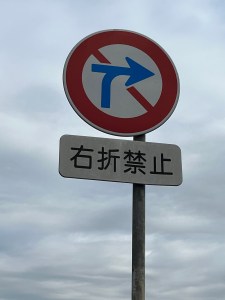
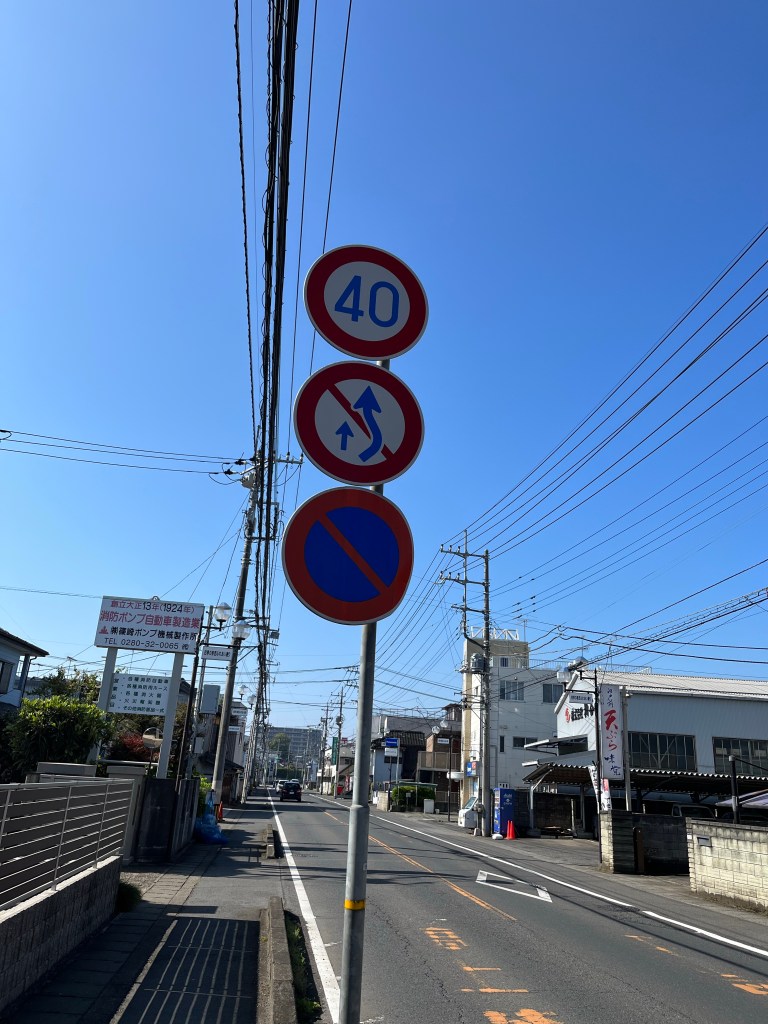
7. The “no crossing the right lane” sign looks almost like the “bicycles and motorcycles must not cross the road in two steps” sign.
Huh? Yes, if you drive on the left side, crossing the road to your right means you will be in the way of other traffic. So crossing the right lane on a street with heavy traffic will cause disruptions and maybe even accidents.
But what about the bicycles and motorcycles? Both signs feature two arrows showing you going first straight, then to the right. Cars would be turning across traffic if they did. And motorcycles would be turning not only across the oncoming traffic, but also the traffic in the same lane – since they are typically driving on the inside of the cars, next to the sidewalk.
The bicycles and motorcycles are supposed to stop and wait at a crosswalk, not barrel across the road – since they can pass traffic in the left line on the inside, and then go across both the left and right lanes. Which would put them in the path across both the oncoming and passing traffic.
8. There is a special sign showing that cars can drive on railroad tracks
Japan is a railroad paradise, despite cars being both common and necessary in most parts of the country. But railroads everywhere means railroad trscks everywhere. In particular in industrial areas, where heavy truck traffic coexists with train deliveries. In Japan, there are railroad tracks and streetcars in plenty of roads – and in many of those, the tracks (sunk into the roadbed) are the only places you can drive a car. To make sure drivers understand it is permitted (since it is forbidden everywhere else), there is a special street sign allowing it.
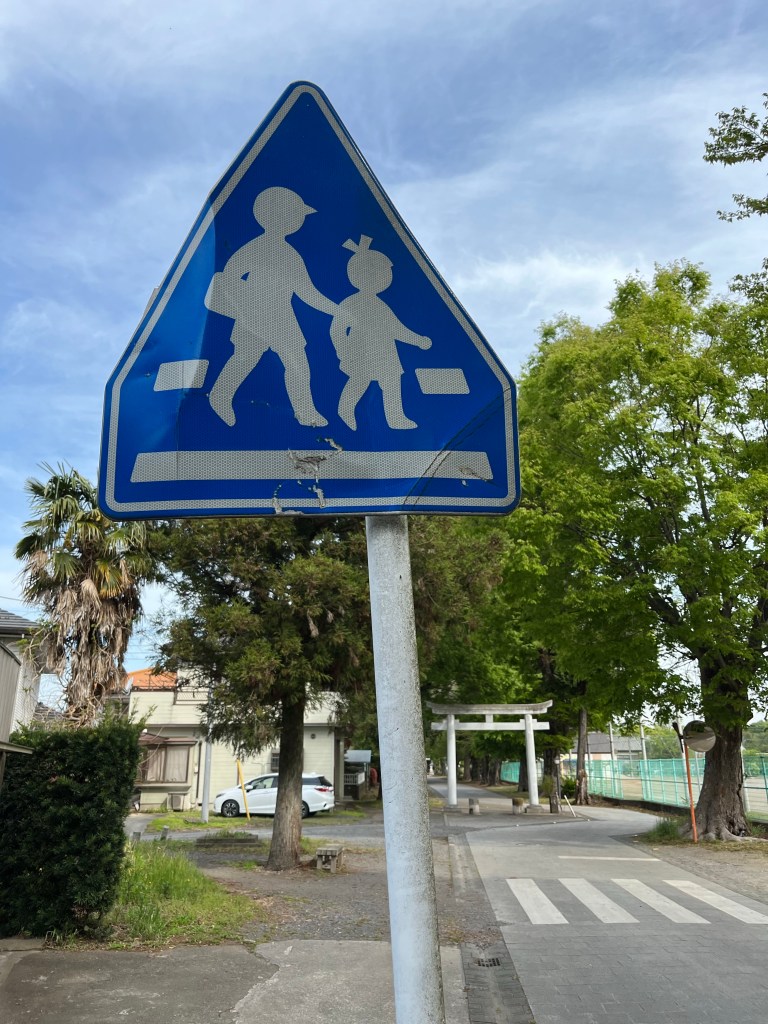
9. There is a special sign for school childrens road crossings.
Crosswalk signs in Japan are triangular but otherwise they look like crosswalk signs in other countries, with a gentleman walking across the lines painted on the road. But not all of them. There are special signs warning drivers for crosswalks that will be used by school children.
The crosswalks in front of schools, and other places on the kids route to and from their school, will have a different crosswalk sign: The same triangle, with the same road markings, but instead of a nan, there are two kids crossing – the same kids as on the yellow “watch out for school zone” sign, which has not changed in 20 years. Or more. To the Japanese, it says “school” so much that no explanation is necessary.
10. When there is a line under the speed on the speed restriction sign, it means minimum speed, not maximum.
Japan has plenty of speed restrictions. Not that you are ever able to drive very fast, except on the freeways. On ordinary roads, the fastest you are allowed to drive is 50 mph (80 kilometers per hour). On ordinary roads, the speed restrictions appear in plenty of places, cutting the speed from 37 mph (60 kilometers per hour) to 31 mph (50 kilometers per hour), then 25 mph (40 kph), 19 mph (30 kph) or even 12 mph (20 kph).
But on the expressways, the speed limit is much higher. Normally, the slowest you would drive would be 50 mph (80 kph). Yet on the Japanese highways you can see speed limits of 40, 50, or 60 kilometers per hour. The secret is that on the highways in Japan, there is a line under the speed numbers on the sign. This means the speed limit is not the top speed allowed – it is the slowest you are allowed to drive.
Please answer a few questions about driving in Japan here!

