Pedestrians in Japan have it easy. They have absolute right of way, which means that all other traffic has to yield to them.
But even do, pedestrians are expected to follow the rules, too. And even though you would not believe it from the way many people behave on the road, there are quite a few regulations for pedestrians in Japan.
1. No Jaywalking
You do not have to spend many days in Japan to see an old lady crossing the street diagonally, grasping her shopping cart, oblivious to the traffic around her.

2. Pedestrian Crossing
As a pedestrian, one of the most important places on the road are the places where you can cross. Do not do like elderly Japanese pedestrians who todder across the road at any possible place (diagonally). Use the crosswalk (or zebra crossing, but in Japan the only zebras are in zoos). Cars are supposed to stop and wait for you if you stand at the crossing, but this very rarely happens.
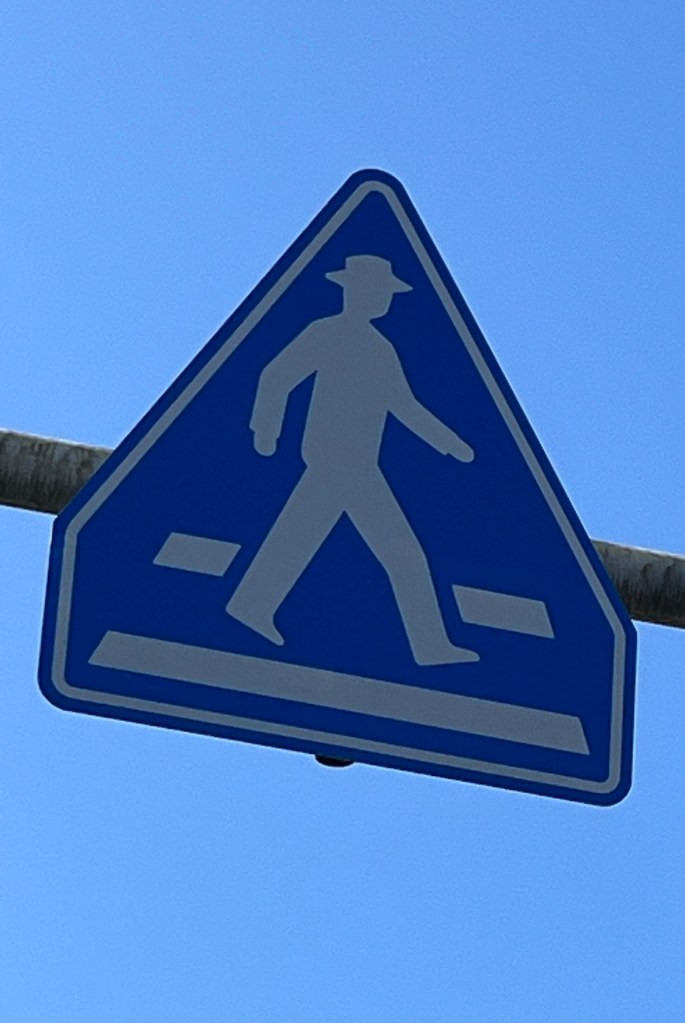
The crosswalk sign in Japan is not quite a triangle, it is a triangle sitting on top of a rectangle; the rectangle contains the crosswalk, and the triangle a man crossing with spring in his step, wearing a hat and probably a suit, but this is hard to see.
Of course you can see the white lines on the road under the crosswalk mark, except in winter in northern Japan, when they will be covered in snow. In the Tokyo area, there may be snow once a year at most, but other parts of Japan see much more snow (there can be more than two meters in Hokkaido already in November).
3. Pedestrian Crossing For School Children
The most common pedestrians in Japan are the children walking to school, usually between 0730 and 0800. School starts at 0815, so then they are supposed to be in class already.
Japanese school children have looked the same since WWII, at least if the road signs are anything to go by. The sign that cautions you that you are in a school zone has looked the same ever since then. Children also use backpacks designed the same way as their parents (newer models feature a laptop pocket, but look exactly the same).
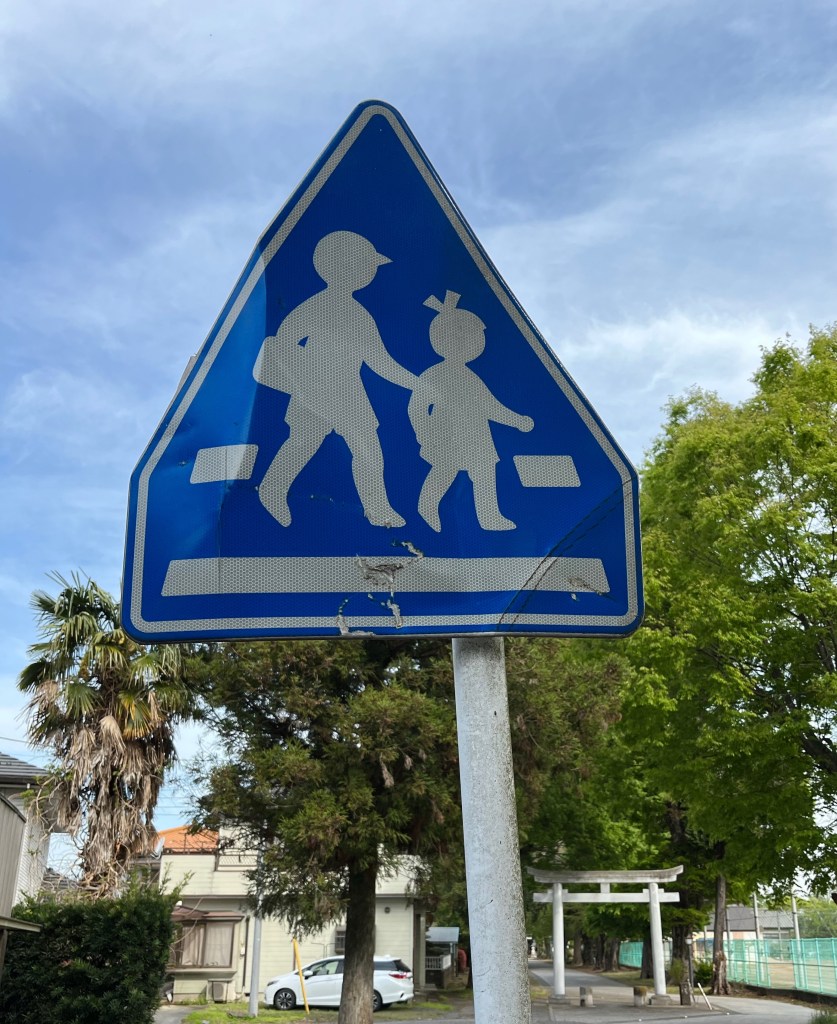
The children are often managed by their parents, volunteers, or the teachers themselves when they come to tricky locations like crosswalks. Especially if there are no traffic lights, the teachers or volunteers will collect them and then stop traffic holding their yellow flags, so the children can cross.
But even if this is a pedestrian crossing that children frequently will use, that does not mean other pedestrians can not use it. At times other than those when children go to and from school (and then too), the school children’s pedestrian crossing is a crosswalk for everyone else as well.
There are plenty of exceptions in Japanese traffic. You can read more about them here.


4. School Route
The two children on the school crosswalk sign is a well-known image for Japanese. The “School Zone” yellow diamond sign (formally an informational, rather than instructional, sign) has featured two children, probably a big brother escorting his sister to school, for more than 50 years.
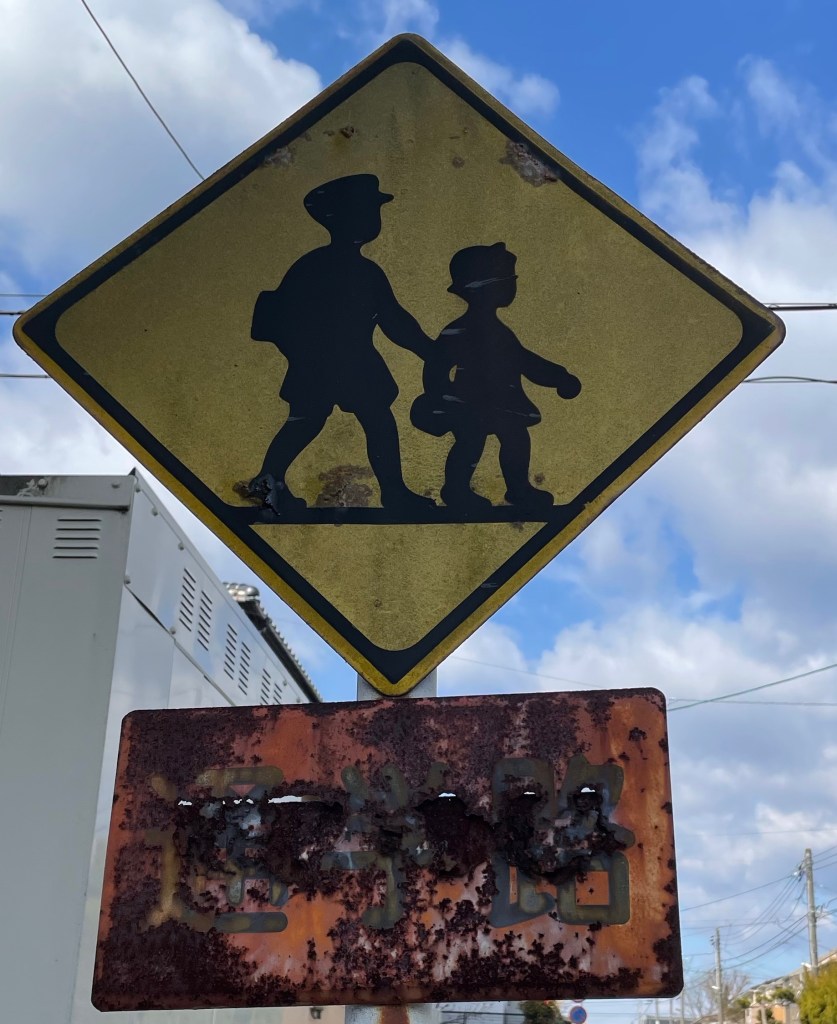
You will find these signs spread out in multiple locations in cities, mainly in residential neighborhoods. Sometimes they remain after schools have closed (which happens a lot in a country where the average population is rapidly growing older and school children fewer).
There is always a reason to be extra watchful when you see this sign, even at times when the children are in school: where there are school children, there is a probability that their smaller siblings are at home. Playing. And likely to run out into the street.
5. One-Way Street
Usually, even in the tight quarters of Japanese cities, the streets are bidirectional – vehicles appearing only rarely enough never to meet each other, cars able to get around without encountering anyone else until they can reach a road which is wide enough to handle traffic in two directions.

But there are many places where the roads are too narrow for two vehicles to meet. The solution is to make the streets unidirectional, usually the first in one direction; then the next in the other.
Why do you need to worry about that? Because if the road is too narrow for two vehicles to meet, it will also be too narrow for a person to meet (or pass) a car. So you need to step aside while the car passes.
6. Dedicated For Pedestrians
On Japanese streets, actual pavements are very uncommon. The pedestrian (and bicycle) zone is a line about 40 cm from the dirt edge of the road.
But if the pedestrian space on ordinary roads is so limited that you can hardly put one foot beside the other, there are plenty of dedicated pedestrian (or pedestrian-bicycle) paths in Japan, although they are usually in the parks or green spaces, not along the roads.
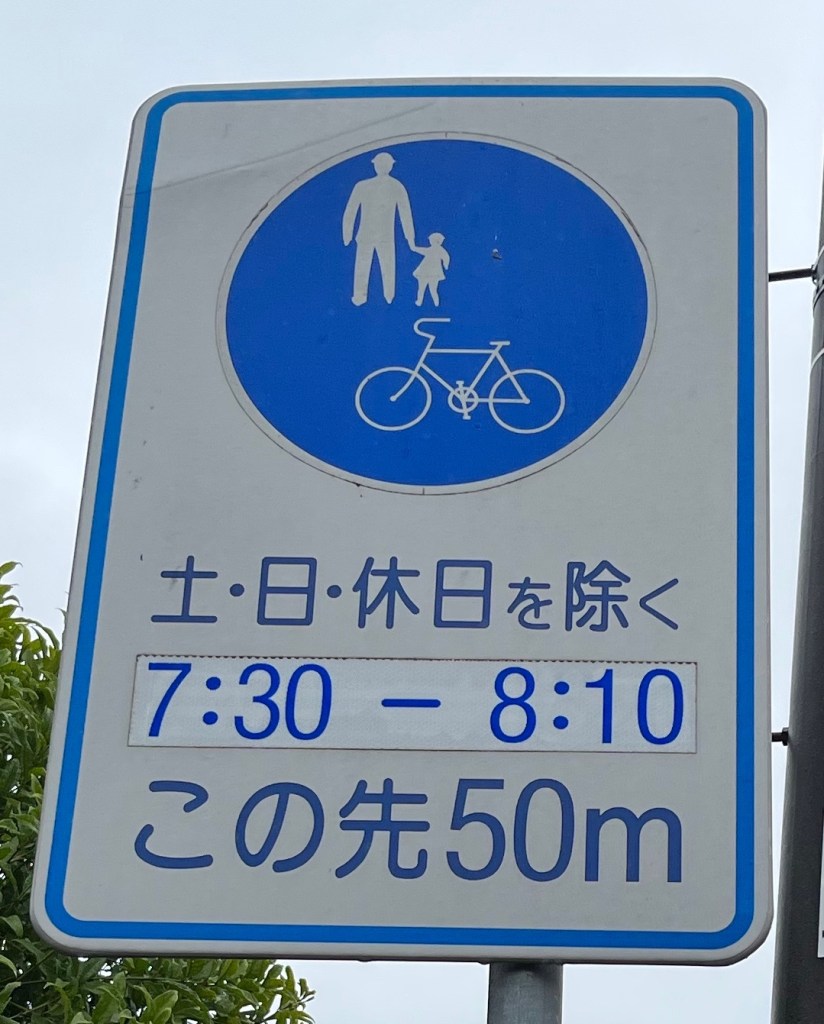
There are several places in most ordinary residential areas where cars are not allowed to drive, at least not during certain hours, to make the roads safe for pedestrians. Many places in Japan have so narrow streets that it is not possible for a car to pass a person standing at the side of the road.
So to make those roads safe for pedestrians – read schoolchildren – the streets are dedicated to pedestrians during certain hours, usually in the morning when children are going to school. The Japanese elementary schools start at 0815 so after that the cars have free rein again.
7. Bicycle Lane
Bicycles are supposed to ride on the street, if they are not operated by elderly or very young riders, in which case they are supposed to drive on the pavement. In case there is one, because on most Japanese streets, the pedestrian – and bicycle – zone is about 40 cm wide, and only shown with a white line.
But there are places where the streets are wide enough to have a sidewalk, and if that sidewalk is wide enough there will be enough space for both bicycles and pedestrians. They have got along fine up to now, but since bicycles have become more aggressive and faster, and pedestrians slower and more immobile, their peaceful coexistence has become harder and harder.
So to organize them, and make sure to get bicycles off the street (where many of them are riding), the Japanese road authorities created bicycle lanes where possible. Usually they will show a sign with a pedestrian and a bicycle, and then separation in two different lanes with pictures on the roadbed. But there is also a sign with two bicycles riding side by side, telling you that there are two bicycle lanes in parallel just there.
8. Personal Vehicle Motor Traffic Prohibited
You do not see it very often, but there are roads in Japan where cars are prohibited. You have to read the exceptions carefully, because even if the sign means that motor traffic is prohibited, there may be trucks going to and from the shopping centers and factories.
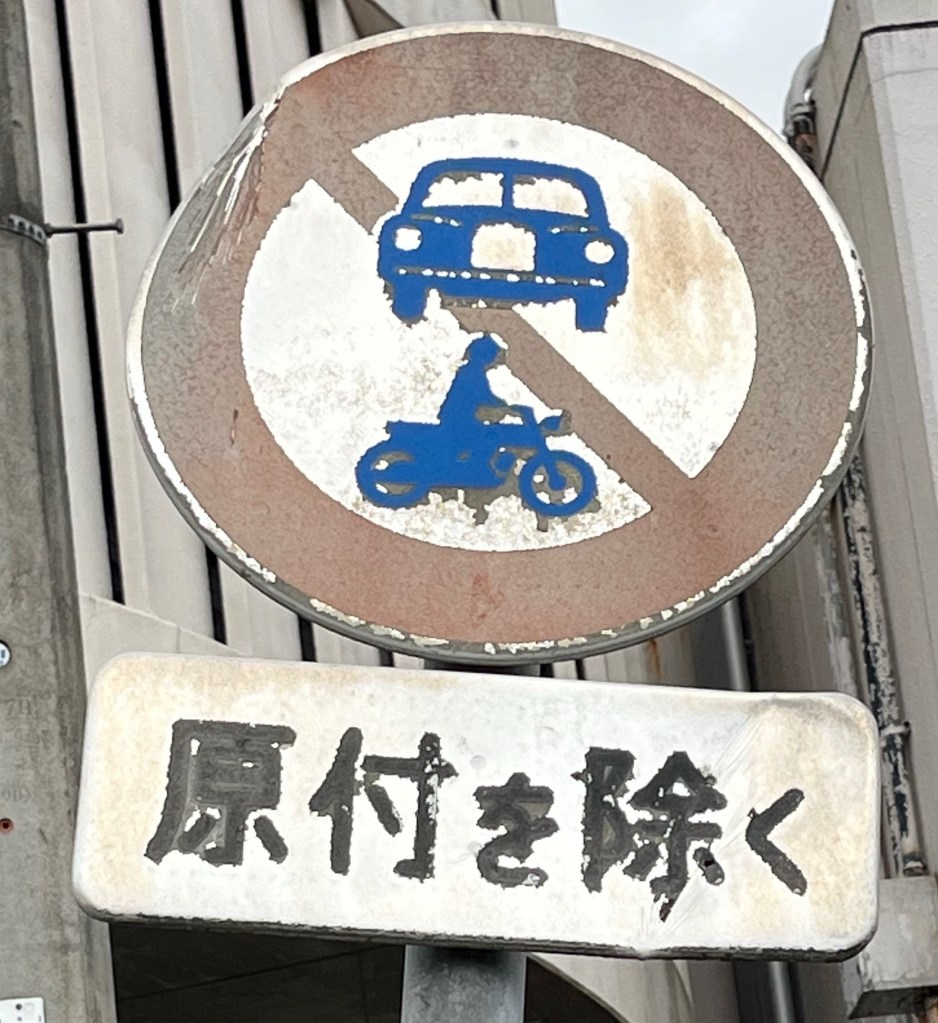
When you see this sign, it does not mean you can go ahead and walk there as you like; rather, you must watch out for trucks as you enter.
9. Stopping Area
There are very few places on Japanese streets where a car can stop. If you try to hail a taxi and they just keep going, that may be one reason they are ignoring you – there is no place they can stop to pick you up.
In principle, cars are forbidden to stop where the street is too narrow; where there is a cistern or a manhole for the fire brigade; within five meters from a crosswalk; and anywhere there is a diagonal grid marked on the street (usually in front of police and fire stations). It is also prohibited to stop at bus stops. And there are typically “no stopping” signs everywhere. It is easier to figure out where you are allowed to stop than where you are not.
The reason is that there actually is a sign showing where you are allowed to stop. It is a square blue sign with the character 亭 on it. Keep an eye out for it if your feet get tired, it is the best place you can find to flag down a taxi. With the exception of the taxi stands, of course.
10. Route Changed
Roadworks in Japan often means that the road is blocked, but it is rare that the entire road is closed. Mostly roadworks in Japan are done on one side of the road, which is feasible since the only reason to dig up the road is to get at the sewers, water, or gas pipes, which are rarely disrupted. Electricity, cable-TV and other electronic services run in cables hanging from the utility poles. Even when replacing those, the crews will only use half the road.
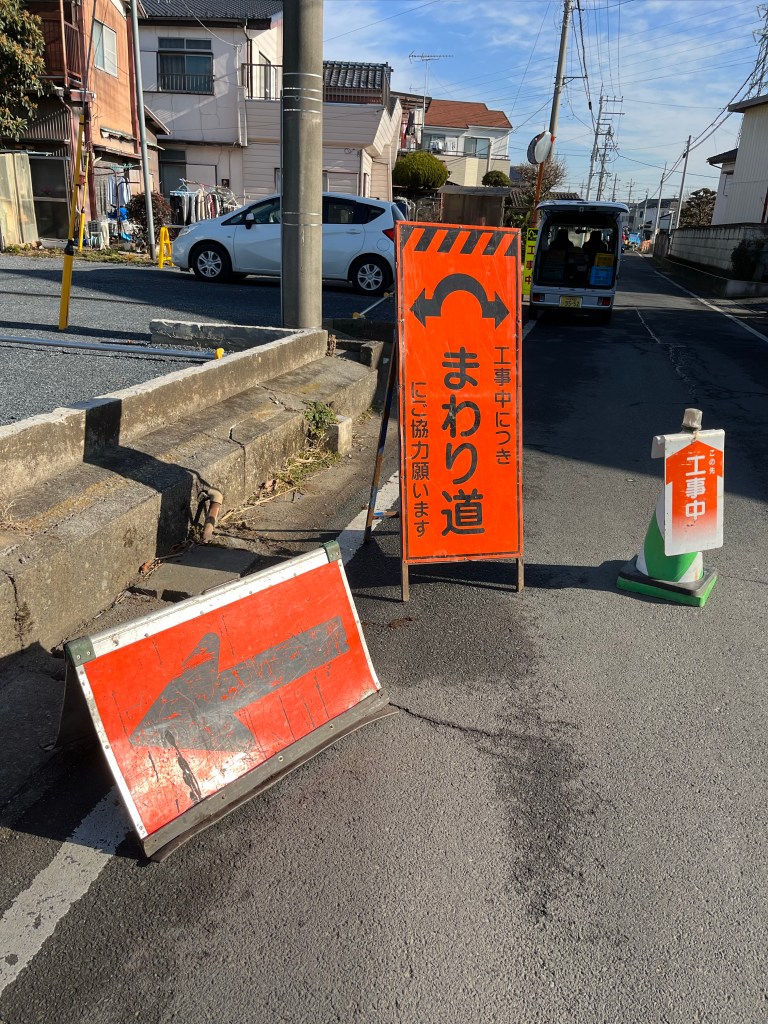
But of course, when the water pipes, or sewers, or other underground infrastructure has to be replaced, there will be an even bigger disruption. And in big cities like Tokyo and Osaka, digging up the street is quite common, as it is the way to access underground serviceways and create underground entrances to buildings.
When that happens, the road will be entirely cut off, and any traffic (be it cars or pedestrians) will be redirected to different streets. Typically, such disruptions happen at night, or during the early morning. As a pedestrian, you will have to walk around the block, instead of to the place you were planning to go.
Did you find this interesting? Then you will probably like my book “Driving In Japan” the only book you can find on the subject. You can read more about it (including the table of contents) here, and if you want to order the book, follow this link to get to your favorite ebook (or pocketbook) store.
 Japan Top 10