When you are thinking about a road trip, especially when you are traveling in an RV, you need to plan the trip. Even if the navigation system is bilingual, it is hard to use outside of the campervan, and hard to use for trip planning. On your mobile or tablet you can use a mapping application like Navitime, Apple Maps or Bing Maps. Or Google Maps, which has the advantage of not just being a mapping system, but has a library of facts about a multitude of places, including reviews, but probably more importantly things like opening times, telephone numbers, web sites, and reviews. Google even verifies the opening times and phone numbers of the different locations.
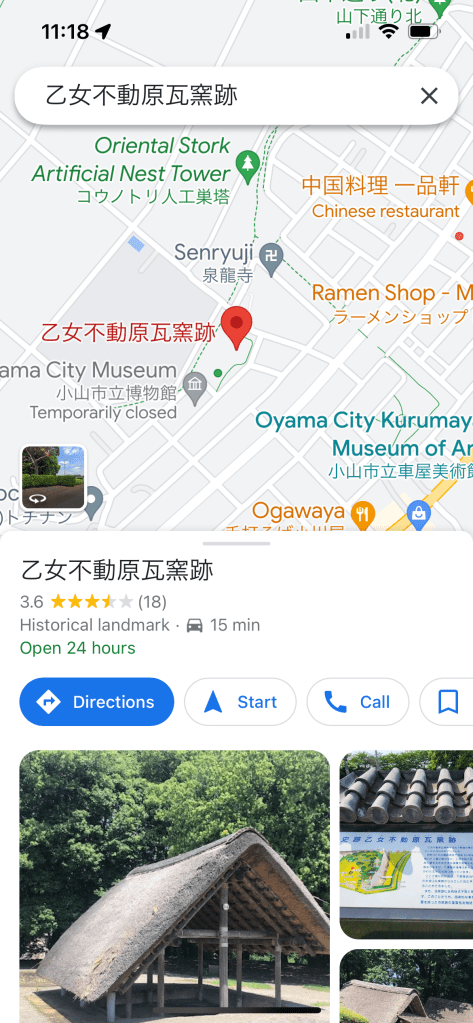
One important thing Google Maps do not tell you is where to stop for the night. Even though there are many parking spaces in Japan, they are not all open to people staying overnight. Actually, very few are.


Showering, Bathing, And Finding Toilets
Most Japanese RVs do not come with toilets. And if they have toilets, they will be locked. The staff does not want to have to clean them, and you do not want to have to empty them.
But this is not a problem, because Japan is full of public toilets, and they are all spotlessly clean. Even in remote areas there will be restrooms at parking spaces, because in Japan you can not park anywhere, you have to park at the designated parking spaces. And if you visit an attraction, you are likely to arrive after a long trip. If you have been on a long trip, you are likely to need a bathroom.
Toilets in shopping centers will be even cleaner and better maintained. There is always a record of who cleaned it and when. The same with toilets in train and subway stations (and bus stations, if there is a heated waiting room). And toilets in public parks are also serviceable, but since they are usually open to the elements, they will be more rustic and maybe not so polished as indoor toilets.
But those are not the only toilets available. You can always use the public toilets in the convenience stores. And the public toilets in the “michi no eki”. The toilets are usually open 24 hours, even if the other services at the waystations are closed. Because the parking lots will be open.
One thing you will not find at the michi-no-eki – other than with a few exceptions – is public showers. To take a bath, or even a shower, you will have to visit a public bath. Even if many public baths have closed, there are still at least one even in relatively small ciyies, and usually at least one in onsen resorts. If you are planning on taking a shower every day during your trip, it is possible. But it will requite a bit of planning. You have to ponder driving times and opening times, both for the public baths and attractions.
Luckily, the public baths (known as onsen if they have naturally flowing hot water, and sento if the water is heated) are usually open late, often past midnight. But they also open late, often around 5 PM. Check the opening times, because it may depend on the season – in the ski resorts, for instance, opening times are minimal in summer, but extended in winter.
Staying Overnight And Preparing Your Meals In A Camping Car
Japan is a tied together by trains and buses. There is public transport close to everywhere, even if the time tables may be rather sparse. But once you get outside the cities, where things are in walking distance if they are not a few stations away, the car takes the driving seat. In the countryside, Japan is in every way as much a car society as the US, and in many places you could believe that the strip malls were in Canada or the US, if you did not know better.
But there is a big difference: Parking lots are private properties, and you have to follow their rules. Which typically includes “do not sleep in your car” and “no barbecues or cooking” (even if the formulation may be more Japanese and polite).
The convenience stores that line the city streets typically have huge parking lots, and those of home electronics, home improvement, and grocery stores are even bigger. But even in case they are open 24 hours, they will not allow you to stop there overnight; if you do, a guard or even a policeman will come knocking on your door.
There are, however, places which allow you to park a campervan overnight (even if some of them also have strict regulations). Some will even welcome you.
Attractions and sights have parking spaces, but if they are not too remote, there will be an attendant who makes sure they are empty when the attraction closes. But if the location is open 24 hours and it is remote enough, then parking there overnight is no problem.
There are, however, locations which welcome overnight parking guests. Stopping at a michi-no-eki at night is allowed – but it is not a camping site. You can not bring out your camping gear, and you can not cook. Parking your car and sleep there is perfectly allowed (and it is very convenient to have the toilets near at hand).
Michi no Eki have huge parking lots (for Japan), and at night they are popular with truck drivers who have to stop to get in their legally mandated rest hours. But not only truck drivers; the parking lots are filled with ordinary cars with the drivers sleeping on their way to their destination. Even more important is that parking at the michi no eki overnight always is free.
The easiest way to find michi-no-eki is looking at the map. They are clearly marked, but may not be directly in your path. You can also look at the Michi no Eki association website, but it is only in Japanese.
Another alternative is camp sites. There are many in the tourist areas, and recently there has been an upsurge in campervan sites, where you can hook up your RV to the electric grid, and there will be showers, toilets, and often wifi as well. The downside is that they are sometimes (most of the time) charged for.
The campsites will be as easy to find on the map, but if you want to look them up in advance, the Japanese National Tourist Organization (JNTO) has a long and detailed list with addresses and phone numbers. As the number of campsites continuously changes (and many RV friendly sites are added), looking at the map is easier than looking at the list. You never quite know how up to date it is.
Navigating The Roads Of Japan In An RV
It can be hard to drive a kei car (the smallest type of car in Japan) through the streets of a Japanese city. Now imagine scaling this up three times. A Japanese RV has the same form factor as a small truck, so if you can drive a U-Haul truck, you can drive a campervan in Japan. Even the biggest campervans or camping car (which sleep eight) are designed to fit in tunnels and be possible to drive anywhere you could drive a small truck.
If you use a campervan for your road trip there are several advantages. It gives you a lot of freedom to go where you like. Staying in a camping car is cheaper than staying in a hotel. You are bringing everything with you, instead of sending it in advance. And if you find the right place, you can cook your own meals.
There are three things you need to plan if you are traveling in a campervan. The first is to make sure the roads are wide enough, and without serpentine bends that will be trying for you as a driver and may be hard to handle with the longer wheel base of an RV. The easiest way to do this is to stay on national roads with a double-digit designation. Anything which is over 100 has the risk to be a smaller road, where you will have trouble meeting other cars, especially in the mountains. The lower the number, the bigger the road (route 4 is wider than the freeways, even if the speed limit is lower).
The second thing is to figure out if you can get to the sights and attractions before they close. Google Maps is very helpful here, as it will tell you both the opening hours and the time required to get from your current position (or next location) to the goal. You can then see how realistic it is to get there before closing.
Make a plan before you go, but make sure it is flexible enough that you can change things around, skip some, and do others instead of each other. It is easy to get locked in a bucket list plan which pressures you to stress from one place to another. Don’t do that. There will always be places, sights and attractions you can not see. Japan is full of sights and views, natural and historic, and modern constructions like amusement parks and museums.
If you spend some energy to plan ahead, you can find great (free) locations to stop overnight, where there are toilets and often simple restaurants or convenience stores nearby. With toilets, because Japanese RVs either do not have toilets at all, or they are locked. Michi no Eki (道の駅) are favorite locations, and nowadays there are also parking spaces dedicated to campervans in many places. Often connected to a more traditional camping site.
With a campervan, you will probably want to make a little bit longer trips. But for the destinations, you probably want to check the tips I put together about five different road trips in Tochigi, Gunma, Saitama, Chiba, Kanagawa, or Ibaraki – the prefectures that consist the Kanto region. Actually, I should include Tokyo as well, because it is not just a city, it is a prefecture as well. Nobody else will tell you what you should not do when you plan a road trip, and of course I also tell you what you should think about when you are planning a road trip in Japan.
Where To Rent A Camping Car
There are several firms that provide camper van rental, but there are a few that stick out, and not just because they offer service in English, including a hotline to call in case you run into trouble.
The following selection is completely personal and does not have any other background than my own personal research, but it may be able to help you find a camping car when you need one – because they are in very high demand in the season.
First Japan Road Trip, who not only has a variety of camping cars on offer, they will also go with you on a ride to make sure you get the finer points of driving an RV in Japan.
Then, there is Overland Japan, who specialize in RV trips around Tokyo. They have several excellent itineraries on their website, and the pickup and dropoff location is in Nakameguro, is southern central Tokyo.
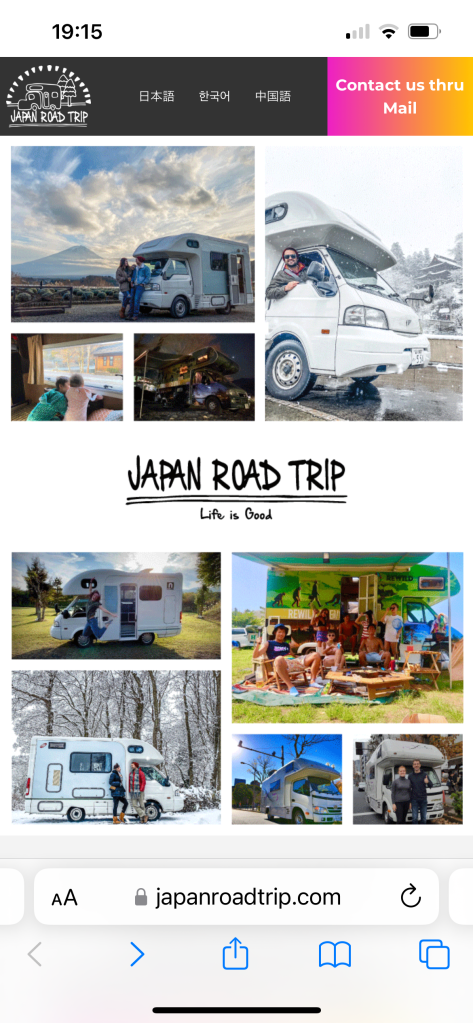
Another company renting RV (or campervans, or camping cars) with English support is El Monte RV, which has several locations around Tokyo and even in Hokkaido.
Japan RV Rental is another company with English services and offices in several locations in Tokyo, Sapporo and Osaka. Japan CRC has branches where most other motorhome rental in Japan companies do not, including several Tohoku locations.
Japan Campers go a little beyond the standard tourist offer by providing a tablet with an English navigation location that includes camping car friendly overnight stop locations – and even portable toilet rental, if you are going very far from any convenience stores.
As mentioned, this is a very quick and unscientific selection, so do your own search to find a camping car rental in Japan that works for you.
What To Look Out For When You Rent An RV In Japan
Regardless of which rental car company you go to, there are a few things you need to consider to make sure you get the best deal. Let me list up some of the things:
1. 24-hour English emergency service
This is like an umbrella: Nothing happens if you have it. But if something happens, and you are not a fluent Japanese speaker, this is golden.
2. Free miles (or kilometers).
They do not charge very much extra, but if you do not have any limit on how much you can drive, then you never have to think about it.
3. Different return and pickup points (at no extra cost).
Japanese rental car companies usually expect you to return the car where you rented it. There are exceptions, and RV rental companies in particular try to be helpful in this regard.
4. Full insurance included.
As car owners are obliged to have a basic level of insurance, this is always included in Japan. But there are always additions which you have to pay extra for. A campervan is extra sensitive due to its size. the more insurance included in the price, the better.
5. Free wi-fi in the car.
If you plan a road trip in Japan, renting a portable wifi-router is a great deal. Even if there is public wifi in many places – especially convenience stores. But the reason you rented a camping car was that you wanted to get away from civilization. And where there is no civilization, there is no public wifi. So having it included in your car is a great idea.
6. Navigation support
If you are looking for places where you can park your RV overnight, you need to know where that is allowed when you plan your trip. Google Maps is invaluable, but it can not replace tips from locals.
This is especially true if you have children, because it is very hard to see where there is a playground in a park.
7. Help to learn how to drive
Driving on the left is not as difficult as you may imagine. Learning the road signs is much more complicated. But having someone sit next to you and tell you what to watch out for, how to turn without scratching the campervan, and other things that have to do with driving a vehicle you are unaccustomed to in an unfamiliar country, that is the best way of learning to drive a camping car in Japan.
8. Office locations
If a company has only one location, they can be as helpful as they like, they will always lose when it comes to flexibility.
9. Vehicle types and availability
The more choice they can give you regarding the type of vehicles they offer, and the more they have of each vehicle, the better the fit with what vehicle you need and when you need it.
10. Price
Be careful to add up everything before you compare. But even so, there is considerable variation. Make sure to get the best vehicle and service at the time you can get it as cheap as possible.
As you may have noticed, I have written a book about driving in Japan (I went through the books available in Amazon, and am honored to be the only one to write a book that is not only about taking the drivers license test). You can read my top 10 tips for renting a car in Japan here.
Did you find this useful? Then chances are that you will find my book “Driving In Japan” even more useful. You can read the table of contents here, and get the book right away here.
 Japan Top 10