Driving in Japan (the focus of my book Driving In Japan), is surprisingly easy and smooth. As long as you understand what the road signs and other signs along the street are saying.
The small white boards detailing exceptions to the road signs are exclusively written in Japanese. But they are not the only Japanese characters which may appear in traffic, and sometimes they convey things that are not shown on traffic signs, but restrictions nevertheless.


1. The 文 sign
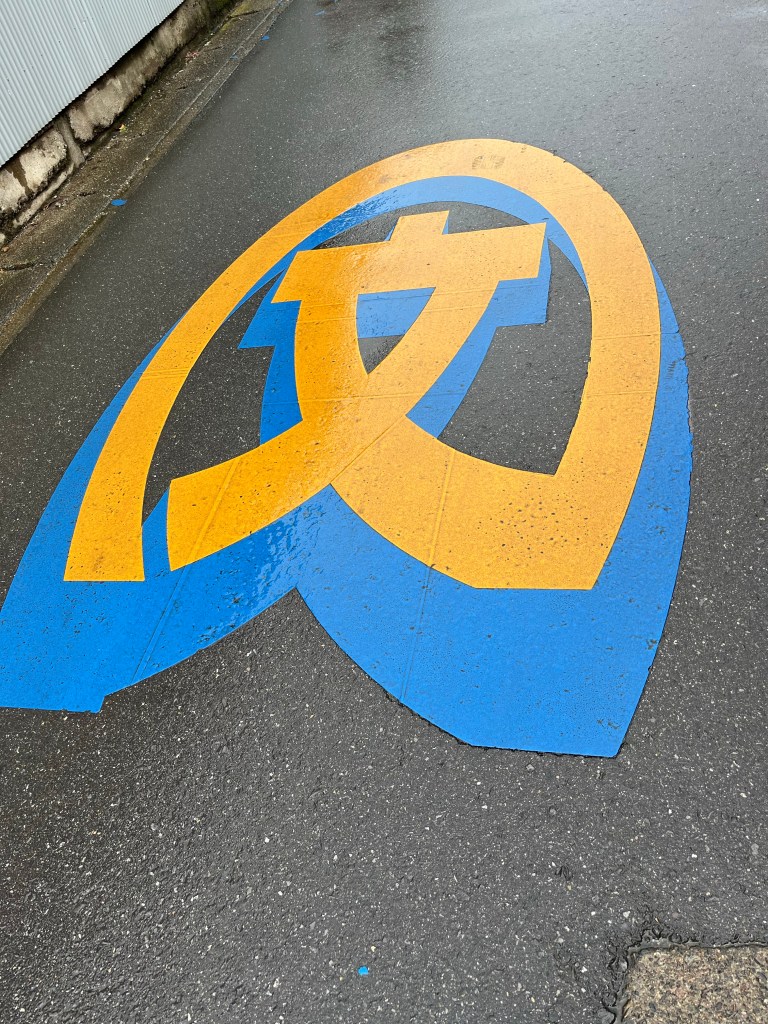
The sign for culture in the Japanese writing system is “文” which is pronounced “bunka”. It means culture, both in the most generic sense and as culturing and being cultured. It is usually used to show that there is a school nearby, although sometimes it appears on the children’s school route as well.
Depending on where in Japan you are, this sign will appear in different ways. In Tohoku, it does not appear around schools at all. In Ibaraki, it is painted on the roadbed; but in Tokyo, it is usually written on small green signs affixed to the utility poles.
In the morning, school children go in groups along pre-determined routes from home to school. There will be volunteers (and teachers) standing around crosswalks and at street lights to make sure that the children can cross safely.
In the afternoon, as they go back from school after 3 PM, they are much more spread out as there are after-school activities like clubs, library, and extra classes. This means children will be going home in drips and dollops from 3 PM to about 5 PM. There is no curfew, but parents are recommended to make sure their children are home before dark, which usually is before 1730. Junior high students, who usually ride bicycles to school, go back even later, sometimes until 7 PM.
2. The Sign For Stop (止まれ).
Japanese stop signs do not look like stop signs in other countries. They are a red triangle with a thin red rim standing on the tip, and the Japanese word for “Stop” (止まれ) written across. Strictly speaking, only the 止 part is a kanji, the まれ part is a verb ending.

But that is only one version of the stop sign. As I have written about in another article, there are four different stop signs. But the only kanji they use is the same.
3. Slow Down
There is one more traffic sign that has an English word on it, as I have written about in the separate article. It is the “slow down” sign. But you need to know the kanji as well, as it is often painted on the roadbead ahead of intersections. Without the word “slow”, only 徐行.
But you also see it on other signs, occasionally on the many admonition signs that line Japanese roads. These are not road signs but put up by the local authorities or neighborhood associations. Typically, they do not use the kanji, they say “Drop the speed” – スピード 落とせ.

4. No Jaywalking
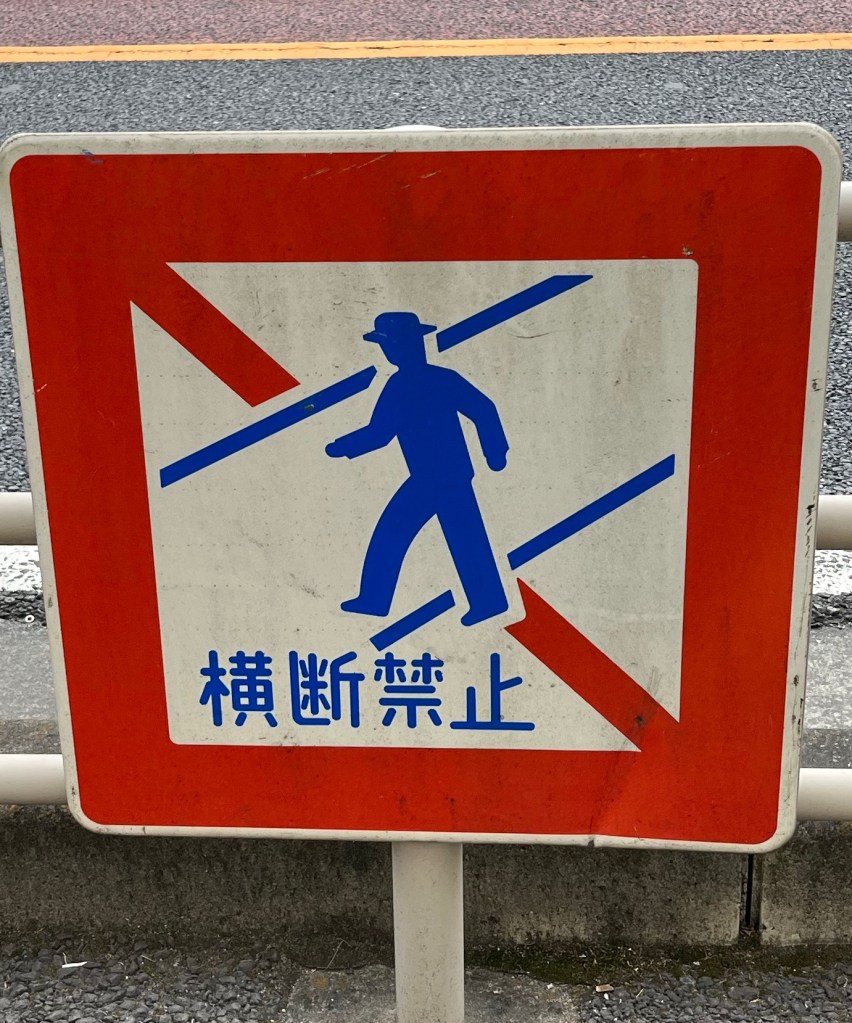
The “no jaywalking” sign is not all that common on Japanese streets, not because jaywalking is so uncommon, but because there are so few places on Japanese streets where it is meaningful to prohibit it. However, there are some places where it would be positively dangerous for pedestrians to get out in traffic. That is where you will see the “no jaywalking” sign.
The text on the sign is 横断禁止, which actually is two words: “odan”, which means to cross or traverse (the word for crosswalk is 横断歩道 (oudanhodou), which also consists of two words: the first part is to cross or traverse, the second is “walking path”. 歩 means walk, 道 means path.
5. Please Press Button
If you are walking, you will appreciate the ability to stop traffic so that you can cross the road. And even though the law is that cars should stop for people at a crosswalk and let them pass, that does not always happen. So you want to activate the traffic light associated with the crosswalk.
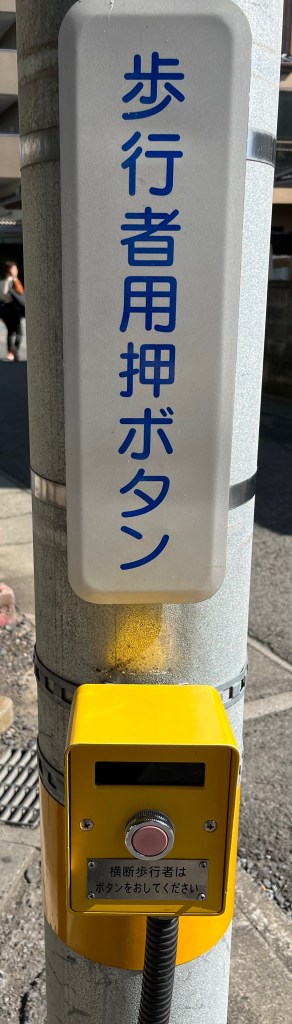
The text says “special push button for pedestrians” – 歩行者 means pedestrian, 用 means for, 押 means push, and ボタン means button.
6. Repeater Traffic Light
Sometimes, you come across two traffic lights in a row that are synchronized. Often, the one you will see first is around a corner from the second one, because it is a repeater traffic light for the light that is located next to the crossing.
Traffic lights in Japan usually have names, written on a small white sign next to the traffic light. This is because the streets do not have names (houses are numbered within the blocks in the order they were built).
But the sign next to the traffic light you came upon first does not show the name of the traffic light. It says “予備信号” which can be translated as “spare signal” – or “repeater signal”.
7. Bicycles Excempted
Japanese traffic signs often come with a small white sign underneath, giving some conditions for how they are supposed to be interpreted. Like, “only valid between 6 AM and 8 AM”, or “does not apply to microbuses and trucks” (common in case of heavy traffic prohibition signs).
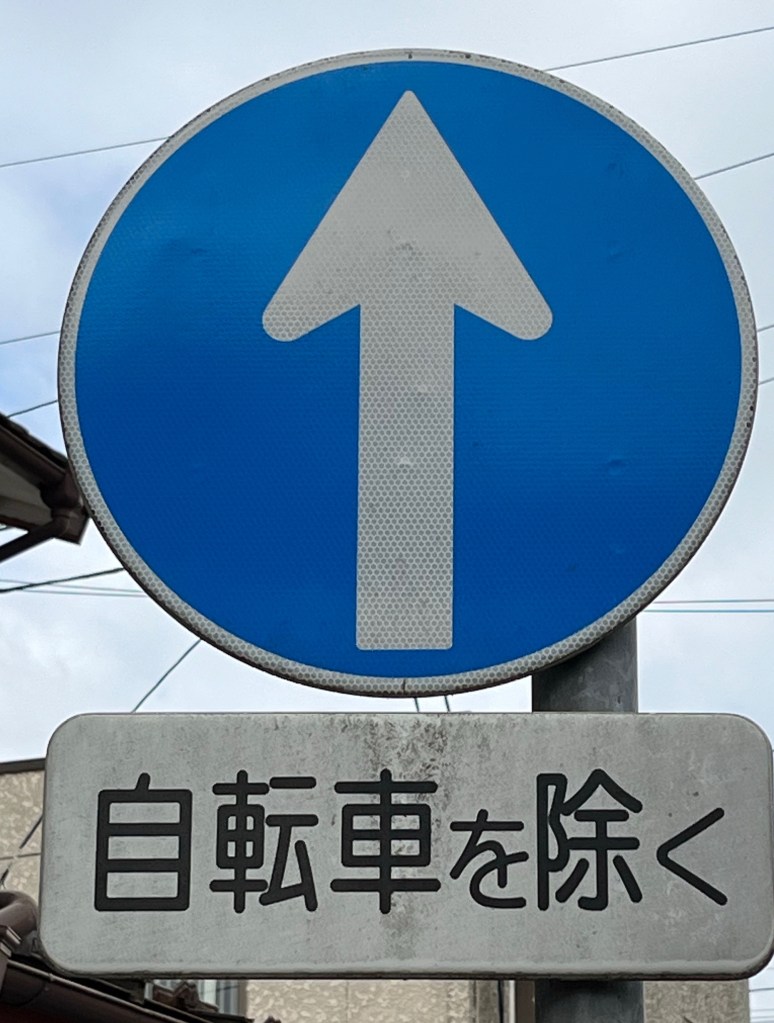
One of the most common exceptions in Japanese traffic is bicycles, which legally considered are not vehicles, but pedestrians with wheels. When there is a white sign underneath the main traffic sign saying “jitensha wo nozoku (自転車 を 除く)” bicycles are exempt from the rule informed by the sign.
8. Dedicated Bus Lane
If you are driving, you may be surprised to find that at certain hours in the day, there is nobody else driving in the leftmost lane. Except buses. And they are looking very angrily at you.
That is because you have entered a bus lane. In Japan, buses are on a strict time schedule like everyone else. But especially in the morning, the traffic can snarl up as much as in an American city, and as a consequence buses would be delayed. If they had to share the lane with cars.
But in Japan, the buses have their own lane. When it says “バス 専用” the lane is dedicated to buses. But not necessarily all day.
If you look at the signs showing that the lane is a bus lane (that has a bus on them) has solid or dashed borders. The ones with the solid border are dedicated at all times, but the signs with a dashed border are dedicated only at certain times (usually in the morning). The hours are written on the signs.
9. Road Work In Progress
You do not find roadworks very often in Japan, since the utility connections to the houses were done when they were built, and only electricity, cable-TV, and fiber connections need to be updated.
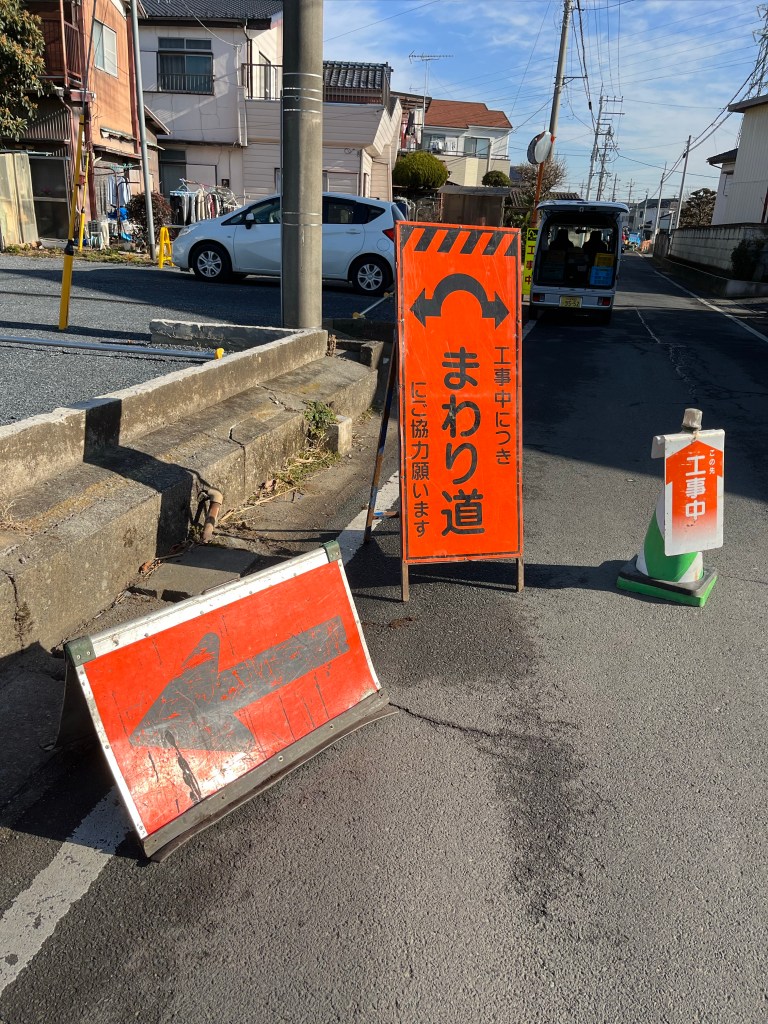
When there is a roadwork, it often means you have to go around the roadwork (工事中) spot – まわり道.
10. Entrance and Exit
They are usually not formal traffic signs, but they appear very frequently in traffic nevertheless.
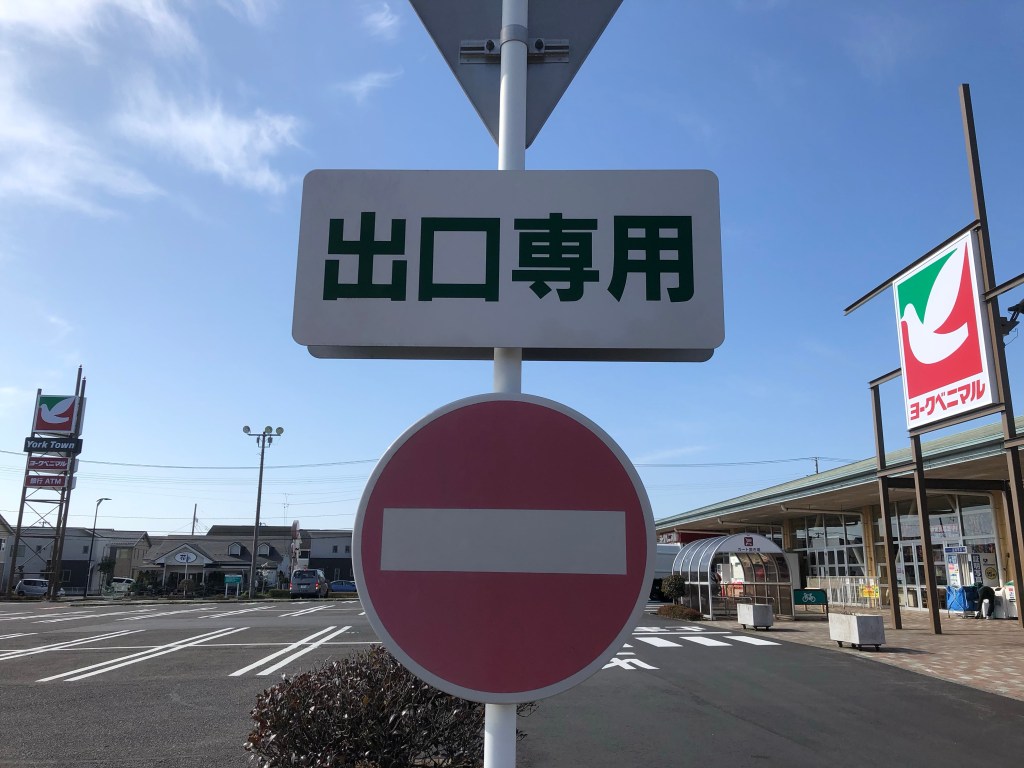
There are often entrances (iriguchi, 入口) and exits (deguchi, 出口) to parking lots and shops from the road you are driving on. 出 means to leave or exit; 入 means enter or insert. 口 means gate or opening; the character is the same as for an open mouth.
If you are driving, look extra carefully. If it is a combined entrance and exit (出入り口) then you need to watch out for cars coming in the other direction.
Did you find this useful? Then chances are that you will find my book “Driving In Japan” useful as well. You can read more about the book on my website, or you can order it from your favorite bookstore using this link.
 Japan Top 10